Explainer Video Length: How Long Should an Explainer Video Be? (2026)

Co-founder of Yum Yum Videos | Explainer Video & Video Marketing Expert

For most focused animated explainers, 60 to 90 seconds is a practical starting point. That is usually enough time to introduce the problem, explain the solution, show why it matters, and finish with a clear next step without forcing too much information into the script.
But there is no single explainer video length that works for every project. A simple homepage video may need 60 seconds. A technical B2B product can justify 90 to 120 seconds. A detailed demo or educational piece may need several minutes.
I have worked in animation and film production for more than 25 years, including the last 14+ years producing explainer and marketing videos at Yum Yum Videos. Across more than 1,000 animated videos, we have found that runtime works best when it follows the message rather than an arbitrary rule.
Current market data points in the same direction. Wistia’s 2026 State of Video analysis covered more than 13 million videos and 79 million hours of content. Its broader benchmark places videos designed to educate or explain in the 1 to 5 minute range, while shorter videos tend to earn higher average engagement overall. For a focused animated business explainer, we normally work toward the shorter end of that range.
Table of Contents
Explainer Video Length at a Glance
| Explainer video duration | Best suited for |
|---|---|
| 30 to 60 seconds | Simple products, awareness, paid campaigns, one key message |
| 60 to 90 seconds | Homepage explainers, SaaS, B2B, product or service introductions |
| 90 to 120 seconds | More complex products, healthcare, finance, technical concepts |
| 2 to 3 minutes | Detailed explanations, multiple features, investor or sales content |
| 3 to 5 minutes | Product demos, tutorials, educational or onboarding content |
These are production guidelines, not fixed rules. A clear 110 second explainer is better than a rushed 60 second one. The reverse is also true: if the message fits naturally into 50 seconds, adding another 40 seconds rarely improves it.
How Long Should an Explainer Video Be?
For the kind of animated marketing explainers we produce most often, 60 to 90 seconds is the range we use as the first planning reference.
A 60 second video forces the script to focus on one problem and one solution. Ninety seconds gives the writer more room for context, product detail, differentiation, and a call to action.
Once a script moves beyond two minutes, we usually ask why the extra time is necessary. Sometimes the answer is completely valid. A medical product may require more context. A new category may need explanation before the product itself makes sense. A technical platform may have several parts that the audience genuinely needs to understand.
The goal is not to make the video short. The goal is to remove everything that does not help the viewer understand the message.
What Is the Ideal Explainer Video Length?
From our production experience, 60 to 90 seconds is our usual range for many animated business explainers.
From Wistia’s broader 2026 benchmark, videos created to educate or explain perform well in the 1 to 5 minute range. Wistia analyzed more than 13 million hosted videos and found that shorter videos generally achieve higher engagement rates, while educational and tutorial content can hold attention at longer runtimes.
Those findings are not contradictory. “Explainer video” can describe several different formats. A homepage animation introducing a SaaS product has a different job from a five minute product walkthrough or training piece.
For this article, I use explainer video length to mean a focused video that introduces and explains a product, service, process, or idea. For that use case, 60 to 90 seconds remains our normal starting point.
You can read Wistia’s current benchmark in its 2026 State of Video report.
60 Second vs. 90 Second vs. 2 Minute Explainer Videos
60 Second Explainer Video
A 60 second explainer video works well when the message can be reduced to one clear narrative.
In one minute, there is enough time to establish a problem, introduce the product or solution, show one or two important benefits, and finish with a next step.
This runtime also makes sense when the video will appear early in the customer journey. A new visitor does not always need every feature. They first need to understand what the company does and why they should care.
90 Second Explainer Video
A 90 second explainer video gives the script more breathing room without turning the piece into a detailed tutorial.
This is the runtime we often use for SaaS, B2B, healthcare, finance, and other products where the viewer needs a little context before the solution appears.
Those extra 30 seconds can accommodate a clearer setup, a second use case, or more detail about how the product works. They should not become an excuse to list every feature.
2 Minute Explainer Video
A 2 minute explainer video can work when the product or audience genuinely needs more explanation.
At two minutes, the script can cover a more complicated problem, several product capabilities, or information that must be explained in sequence.
The risk is not the number “120.” The risk is adding information simply because the runtime is available. If a two minute script contains the same idea repeated three different ways, shortening it will usually make the video stronger.
Explainer Video Word Count: How Much Can You Say?
Runtime starts with the script.
For English voiceover, we usually plan around 140 spoken words per minute for a clear explainer. The exact pace changes with the narrator, subject, pauses, emphasis, and amount of information on screen.
That gives us a useful planning range:
| Runtime | Approximate script length |
|---|---|
| 30 seconds | 70 words |
| 60 seconds | 140 words |
| 90 seconds | 210 words |
| 2 minutes | 280 words |
| 3 minutes | 420 words |
This is one reason we prefer solving length problems in the script instead of during animation. Cutting 30 seconds after the visuals have already been produced is much more disruptive than tightening 70 words before storyboarding begins.
Our explainer video script guide goes deeper into structure, word count, and writing for voiceover.
What Determines Explainer Video Duration?
1. The Complexity of the Message
A product that can be understood in one sentence needs less setup than a new category, regulated healthcare platform, or technical B2B system.
Complexity does not automatically mean a long video. Animation can compress information by showing relationships that would take longer to describe verbally. But there is still a limit to how much new information a viewer can process at once.
2. What the Viewer Already Knows
Audience familiarity changes the amount of explanation required.
A video aimed at specialists can often skip basic context and move directly into the product. A video aimed at the general public may need to define the problem before explaining the solution.
This is one reason the same company may need different runtimes for different audiences.
3. Where the Video Appears
Placement changes viewer intent.
Someone who presses play on a homepage explainer is usually looking for a quick understanding of the company. A prospect watching a product walkthrough deeper in the sales process may be willing to spend several minutes learning how it works.
The right explainer video duration therefore depends partly on what happens before the viewer presses play.
4. The Number of Ideas in the Script
Explainer videos become long very quickly when several departments try to fit their priorities into one script.
Marketing wants the positioning. Product wants the features. Sales wants objections addressed. Legal adds qualifiers. Leadership wants the company story.
We have seen this happen many times in production. The solution is usually not faster narration. It is deciding which information belongs in this video and which information belongs somewhere else.
5. The Visual Style
Style can affect pacing.
A motion graphics video can communicate relationships through icons, diagrams, interfaces, and text. Character animation may need extra seconds to establish a situation. You can see examples of that approach in our 2D animation work. Whiteboard animation often develops an idea progressively. A detailed 3D sequence may need time for the viewer to understand what the camera is showing.
If you are still deciding the visual approach, our guide to types of explainer videos compares the main formats and when to use each one.
Does a Shorter Explainer Video Get Better Engagement?
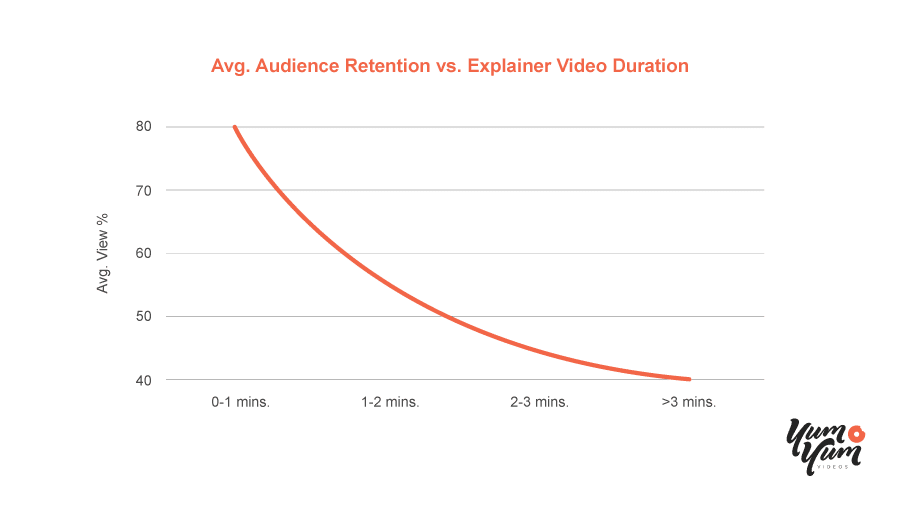
Usually, shorter videos achieve a higher percentage watched, but that does not mean the shortest possible video always performs best.
Wistia’s 2026 data shows that engagement rate generally declines as runtime increases. At the same time, longer videos can generate more total watch time, and some formats hold attention much better than others.
If someone watches 80% of a 60 second video, that is 48 seconds of watch time. If another viewer watches 50% of a three minute explanation, that is 90 seconds.
For an explainer, we care about both retention and comprehension. A viewer reaching the end means very little if the video moved so quickly that the product never became clear.
When Should an Explainer Video Be Longer Than 90 Seconds?
A longer runtime can make sense when:
- The audience needs context before the product can be understood.
- The product has several connected steps that cannot be separated cleanly.
- The subject involves healthcare, finance, engineering, or another technical field where oversimplification creates problems.
- The video sits deeper in the funnel and the viewer already has strong intent.
- The content is closer to a demo, tutorial, onboarding piece, or educational video than a short homepage introduction.
The important question is whether the extra time carries new information.
If minute two simply repeats minute one with different wording, the script is too long. If minute two answers a question the target viewer actually has, it may belong there.
When Should an Explainer Video Be Under 60 Seconds?
A sub 60 second video works when the communication goal is narrow.
Examples include a single feature, product announcement, event, campaign message, paid ad, or short piece designed to introduce a larger content journey.
Short runtimes also work when the visual can do much of the explaining without voiceover.
The challenge is avoiding a script that sounds rushed. Removing seconds by making the narrator speak faster almost always hurts clarity. Reduce the number of ideas instead.
A Real Production Example: Catan

Catan is a useful example of how we think about pacing. The objective was to keep the viewer moving through the explanation without turning the piece into a list of disconnected information.
During production, runtime decisions happen first in the script and then again in the storyboard. If a section needs too much narration to explain what the viewer is seeing, we can simplify the language, change the visual idea, or decide that the information is not essential.
That process is much easier before animation begins.
Our full explainer video production process shows where script, storyboard, illustration, and animation fit into the timeline.
How to Shorten an Explainer Video Without Losing the Message
Cut the Setup Before Cutting the Explanation
Long intros are common. The viewer usually needs less background than the company thinks.
Start close to the problem and move into the solution quickly.
Remove Repeated Ideas
If the script says the same benefit in the problem, solution, feature, and closing sections, choose the strongest version and remove the rest.
Keep One Main Communication Goal
A homepage explainer should not also be a tutorial, company history, feature comparison, customer testimonial, and recruiting video.
When several goals compete, a video series is often a cleaner solution.
Let the Visuals Explain
Do not narrate everything the viewer can already see.
If the animation clearly shows a process moving from step A to step B, the voiceover does not need to describe every movement.
Fix Length Before Animation
Script edits are cheap compared with late animation changes.
At Yum Yum Videos, we resolve the message and pacing before the project reaches final illustration and animation. That is one of the reasons the explainer video production process starts with writing and visual planning.

How Explainer Video Length Affects Cost
Runtime affects cost because a longer video usually requires more script, storyboard panels, illustrations, animation, voiceover, sound design, and review time.
That does not mean a 120 second video always costs exactly twice as much as a 60 second one. Style and complexity matter too.
In our 2026 pricing research, we contacted 125 video production companies. 76 responded, and 61 provided usable quotes for a custom 60 second animated explainer. Prices ranged from $2,800 to $27,000, with a median of $9,680.
The quotes show how much production models vary even when runtime stays fixed at one minute.
Our explainer video cost guide explains the pricing tiers and methodology.
How We Think About Explainer Video Length at Yum Yum Videos
After more than 14 years producing animated videos, we treat runtime as a production decision, not an SEO or platform rule.
Our animated video company has produced more than 1,000 videos for companies ranging from startups to large enterprises. The projects do not all have the same runtime because the communication problems are different.
For a focused animated explainer, 60 to 90 seconds remains our normal starting range. We go shorter when the message is simple. We go longer when the audience needs more context or detail.
The script decides whether those extra seconds are doing useful work.


FAQ About Explainer Video Length
What is the average explainer video length?
Many business explainers fall around the 60 to 90 second range, although there is no fixed industry runtime. Detailed product, training, or educational videos can run longer.
What is the ideal explainer video length?
For a focused animated marketing explainer, we normally start at 60 to 90 seconds. The ideal length depends on message complexity, audience knowledge, placement, and the amount of information the viewer genuinely needs.
How long should an explainer video be for a website?
A homepage or landing page explainer often works well around 60 to 90 seconds because visitors usually need a fast introduction. More detailed product pages can justify longer videos.
Is a 2 minute explainer video too long?
No. Two minutes can be appropriate for a complex product or audience that needs more context. It becomes too long when the additional runtime does not add useful information.
How many words are in a 90 second explainer video?
At the 140 words per minute planning pace we commonly use, a 90 second explainer script is approximately 210 words.
Does explainer video length affect cost?
Usually, yes. More runtime generally means more script, storyboard, illustration, animation, voiceover, and sound work. Complexity and visual style also affect the final price.
Final Recommendation
For most focused animated explainers, start by planning for 60 to 90 seconds.
Then test that assumption against the script. If the audience needs more information, give the message the time it needs. If the idea is already clear in 50 seconds, stop there.
The best explainer video length is the shortest runtime that explains the message clearly without rushing it.

Victor Blasco
Co-founder of Yum Yum Videos | Explainer Video & Video Marketing Expert
Victor Blasco has over 25 years of experience in animation and film production. For the past 14+ years, he has worked with companies to create explainer and marketing videos that simplify complex ideas and drive business results.
His work has supported global brands like Amazon and McKesson, as well as startups that raised over $2B and reached unicorn or IPO stages.
Victor shares insights based on real client work. His contributions have been published on platforms like Social Media Examiner, and he has been featured or quoted in outlets such as Forbes.