How Much Does an Explainer Video Cost in 2026?

Co-founder of Yum Yum Videos | Explainer Video & Video Marketing Expert
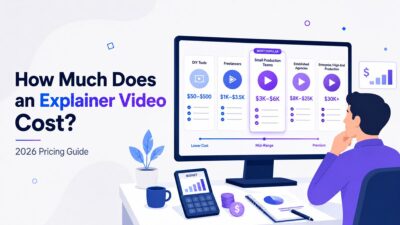
If you ask several production companies how much an explainer video costs, you can get very different answers.
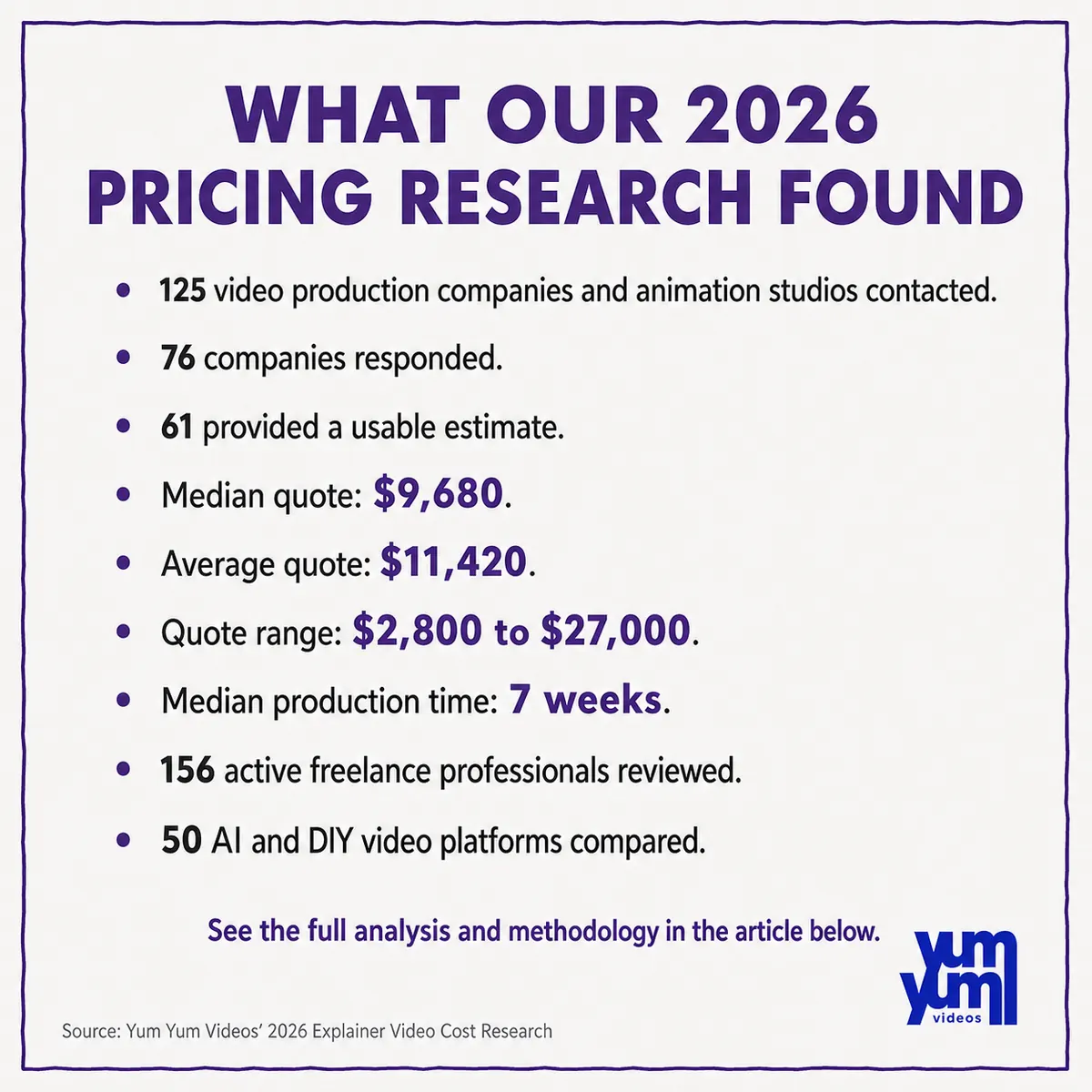
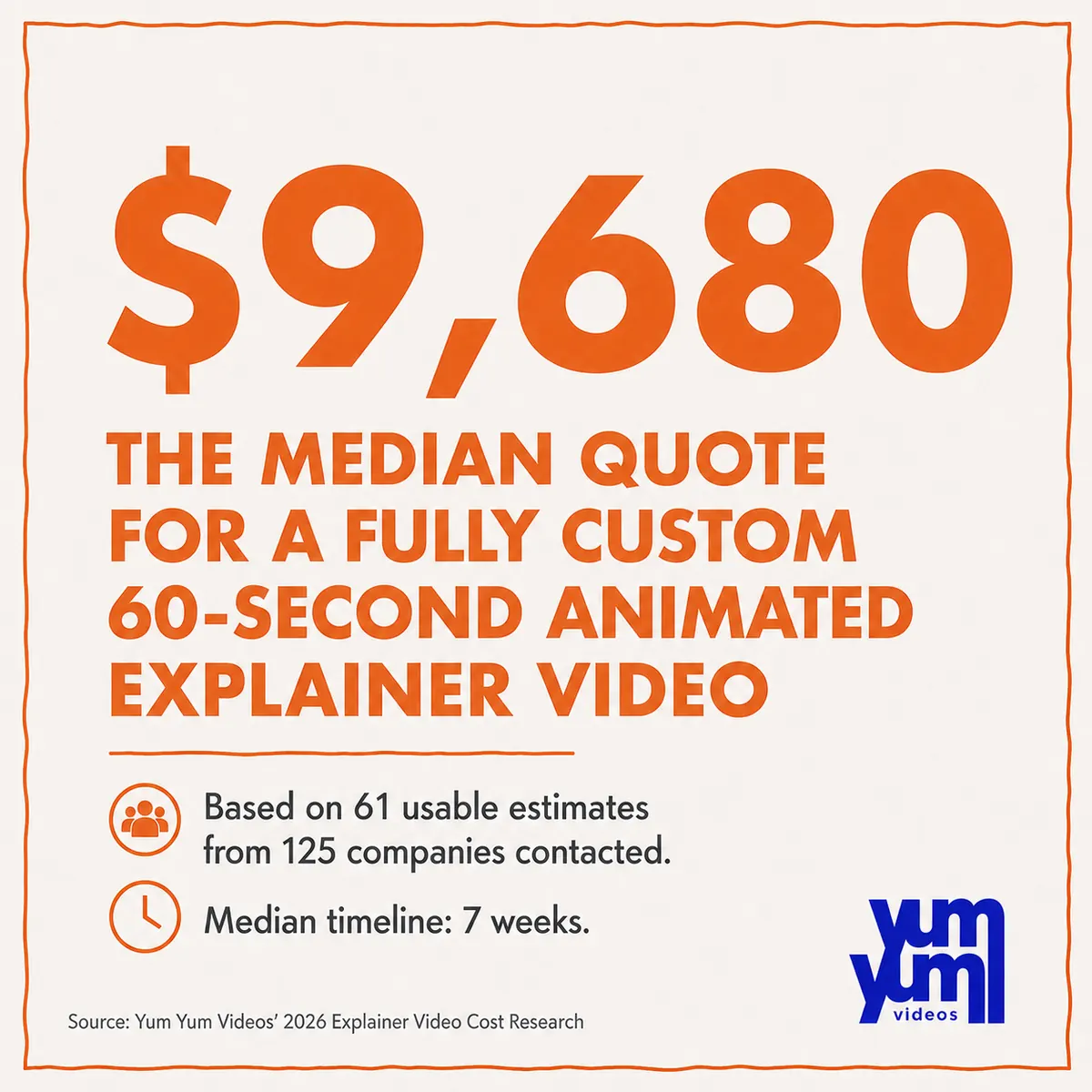
In our 2026 pricing research, we contacted 125 video production companies and animation studios. Of the 76 companies that responded, 61 provided a usable quote for a custom 60-second animated explainer video. Prices ranged from $2,800 to $27,000, with a median of $9,680.
As a practical benchmark, a fully custom 60-second explainer video produced by a full-service video company usually costs between $8,000 and $25,000.
At the other ends of the market, AI tools and templates can cost almost nothing, while complex 3D animation, frame-by-frame work, and large live-action productions can exceed $100,000.
Explainer video cost depends on the animation style, length, customization, production team, revision process, and deadline. Length matters, but so do the animation style, level of customization, number of people working on the project, revision process, deadline, and what the quote includes.
This guide breaks down those differences so you can compare explainer video costs on equal terms and understand what you are paying for.
Table of Contents
Explainer Video Cost at a Glance
| Production Option | Typical Price (USD) | What You Can Expect |
|---|---|---|
| AI Tools and DIY Templates | $0–$500 | Fast production using automated, stock, or ready-made assets. |
| Freelancers | $1,000–$5,000 | Direct access to an individual professional, with capabilities depending heavily on that person’s skill set. |
| Small Production Companies | $3,000–$8,000 | A smaller creative team and a more customized process. |
| Full-Service Video Companies | $8,000–$25,000 | A managed production that can include strategy, scriptwriting, design, animation, sound, and project management. |

How We Estimated These Prices
The ranges in this guide combine our experience producing more than 1,000 custom videos at Yum Yum Videos with our July 2026 pricing research covering production companies, freelancers, and AI video platforms.
You can find the complete research results and methodology later in this guide.

How the Production Model Affects Explainer Video Cost
One of the biggest reasons explainer video quotes vary so much is that they are often pricing very different production models.
A full-service agency, a two-person studio, an independent animator, and an AI platform may all offer an explainer video, but the people involved, production process, level of customization, and amount of work included can be very different.
Full-Service Video Companies: $8,000 to $25,000
A full-service explainer video company normally divides the project among specialists rather than asking one person to handle the entire production.
Depending on the company and project, that team can include a scriptwriter, creative director, illustrator, animator, voice artist, sound designer, and project manager.
This becomes particularly useful when the video has to explain a complicated product or represent a company in an important campaign. Different people can focus on the areas they know best while one production process keeps the work consistent.
Before hiring an agency, look at its explainer video portfolio closely. Don’t just check whether the videos look polished. See whether the company has worked with different industries, can adapt its visual style to different brands, and has examples that resemble the level of complexity you need.
An established production company should be able to explain when you will review the script, storyboard, illustrations, and animation, and what happens when changes are requested.
For a fully custom 60-second explainer, this type of production generally falls between $8,000 and $25,000.
For projects involving advanced 3D animation, extensive frame-by-frame work, visual effects, or a large live-action shoot, budgets can start around $30,000 and go beyond $100,000.
Small Production Companies: $3,000 to $8,000
Small or boutique production companies often have one to three core team members and bring in additional freelancers when a project requires them.
A small team can still produce very good work. In many cases, communication is direct and you work closely with the people actually creating the video.
The main difference is capacity.
A three-person studio cannot distribute ten simultaneous projects in the same way that a larger production team can. Timelines may therefore depend more heavily on the studio’s current workload, particularly if you have a fixed launch date.
For projects where the creative fit is right and the schedule is flexible, a smaller production company can offer a useful middle ground between a freelancer and a larger agency.
Typical explainer video costs range from $3,000 to $8,000.
Freelancers: $1,000 to $5,000
For a smaller budget, hiring a freelance animator or video producer can make sense.
The main advantage is straightforward: you usually work directly with the person doing most of the work.
The tradeoff is that explainer video production involves several different disciplines. Someone who is an excellent animator may not be equally strong at scriptwriting, illustration, sound design, or creative direction.
That doesn’t make freelance production a bad option. It simply means you need to look at exactly what the freelancer is providing and what you will need to manage internally.
For example, your team may need to provide a finished script, define the visual direction, organize feedback, or hire a separate voice artist.
For smaller projects, early tests, or companies with internal creative resources, this can work well.
Freelance explainer video projects generally range from $1,000 to $5,000, although rates vary widely according to experience and scope.
Platforms such as Fiverr and Upwork are common places to compare freelance professionals.
AI Tools and DIY Templates: Free to $500
AI video generators and template-based platforms have made it possible to produce simple content for a fraction of the cost of custom production.
They can be useful when you need to test an idea quickly, create temporary content, make something basic for internal use, or produce content that does not justify a larger production budget.
Most rely on some combination of generated assets, stock libraries, preset animations, synthetic voices, and ready-made layouts.
The software itself can be free or relatively inexpensive, with many paid plans costing less than $500.
The important distinction is between software cost and production cost.
You still need someone to decide what the content should say, write or edit the explainer video script, choose the visuals, review generated assets, select or record the voiceover, and assemble the final piece.
These platforms can also limit customization. If several companies use the same templates, stock illustrations, avatars, or animation presets, their content can begin to look very similar.
For low-risk content, that may be completely acceptable. For a flagship product piece or something that has to represent your brand for several years, you may want more control over the final result.
How Much Does an Explainer Video Cost at Yum Yum Videos?
Our explainer video prices start at $8,000.
At Yum Yum Videos, we have spent more than 14 years producing over 1,000 custom projects for companies including Amazon, Walmart, McKesson, and Thermo Fisher.
A typical custom production includes research and kickoff, scriptwriting, storyboarding, art direction, custom illustration, professional voiceover, animation, music, sound design, and project management.
We also involve the client throughout the process. That matters because some of the most expensive changes in animation are not difficult changes. They are changes requested too late.
The goal of the approval process is to solve messaging and visual decisions while they are still inexpensive to change.
One client described the result this way:
If you need an exact figure for your project, the price will depend on the style, duration, production complexity, and schedule.
Factors That Affect Explainer Video Cost
Two 60-second productions can use the same general animation style and still have very different budgets.
Here are the factors that usually explain that difference.
Customization
Customization is not simply adding your logo and brand colors.
A fully custom production can include an original visual concept, characters designed specifically for the project, branded environments, product interfaces, illustrations, icons, transitions, and individual scenes created around the script.
The more assets that have to be designed from scratch, the more illustration and production time the project requires.
A simple motion graphics piece using geometric elements may need relatively few custom assets. A character-driven project with several locations and dozens of unique shots needs much more design work before animation even begins.
That difference shows up in the quote.
Quality and Production Complexity
When two companies quote very different prices for what appears to be the same one-minute project, look beyond the runtime.
The amount of work inside those 60 seconds may be completely different.
Consider two character animations.
One uses a single character, a simple background, limited movement, and basic transitions.
The other has several characters interacting, changing camera angles, detailed environments, custom transitions, lip sync, complex movements, and visual effects.
Both are technically 60-second 2D animations. They are not comparable productions.
Script development, illustration detail, character design, animation complexity, voice talent, editing, music, and sound design can all affect how many hours are needed to produce the final result.
Expertise and Production Team
Team structure also affects price.
A full production may involve separate professionals for writing, art direction, illustration, animation, voiceover, sound, and project management.
A smaller project may have one or two people covering several of those roles.
Neither structure automatically guarantees a better result. The question is whether the people involved have the skills your project requires.
If your project needs complex medical illustration, for example, that is a different production challenge from a simple SaaS interface animation. If it relies heavily on character acting, animation ability becomes especially important.
Look at the team’s actual work, not just the number of people assigned to the project.
Number and Timing of Revisions
Revision policies are easy to overlook when comparing quotes.
Some companies include a fixed number of rounds at each production stage. Others offer more flexible revision policies. Extra rounds may increase the price or extend the schedule.
But the timing of a revision can matter even more than the number of revisions.
This is something we see regularly in production.
Changing one sentence while the script is still a document may take a few minutes.
Changing the same idea once the corresponding scene has been storyboarded, illustrated, recorded, animated, edited, and mixed can require several departments to redo their work.
A change affecting 20 seconds of completed animation might require a new storyboard section, new illustrations, new animation, voiceover adjustments, editing, and sound design. Depending on the scene, that can add $2,000 or more to a project.
For that reason, we recommend spending enough time on the script and storyboard before approving the next stage.
Moving carefully at the beginning can be considerably cheaper than fixing a problem at the end.
Video Length
Explainer video length remains one of the easiest pricing variables to understand.
A two-minute production generally requires substantially more illustration, animation, voiceover, editing, and sound work than a one-minute production.
The relationship is not always exactly one to one. Some production tasks, such as kickoff and creative development, happen regardless of whether the final runtime is 60 or 90 seconds.
Still, adding runtime means adding scenes, assets, animation, and audio.
This is why most production companies ask about target duration very early in the quoting process.
Turnaround Time
A fully custom animated explainer usually takes around 6 to 8 weeks from kickoff to delivery.
That gives the team time to develop the script, storyboard the piece, design the visual assets, animate it, produce the audio, and collect feedback at each stage.
A faster schedule may be possible, but it can require the company to rearrange other projects, assign additional resources, or overlap production stages that would normally happen sequentially.
For that reason, rush projects may carry an additional fee.
Explainer Video Pricing by Animation Style
Animation style also changes animation costs because different techniques require different skills and amounts of work.
These are general market references for a custom 60-second production.
| Explainer Video Style | Estimated Price for 60 Seconds |
|---|---|
| Traditional 2D Animation | $20,000–$50,000+ |
| Custom 2D Animation | $8,000–$25,000 |
| Motion Graphics | $5,000–$20,000 |
| Whiteboard Animation | $3,000–$15,000 |
| 3D Animation | $10,000–$100,000+ |
| Live Action | $10,000–$100,000+ |
| Mixed Media and Live-Action Animation | $10,000–$50,000+ |
| Stop Motion | $20,000–$60,000+ |
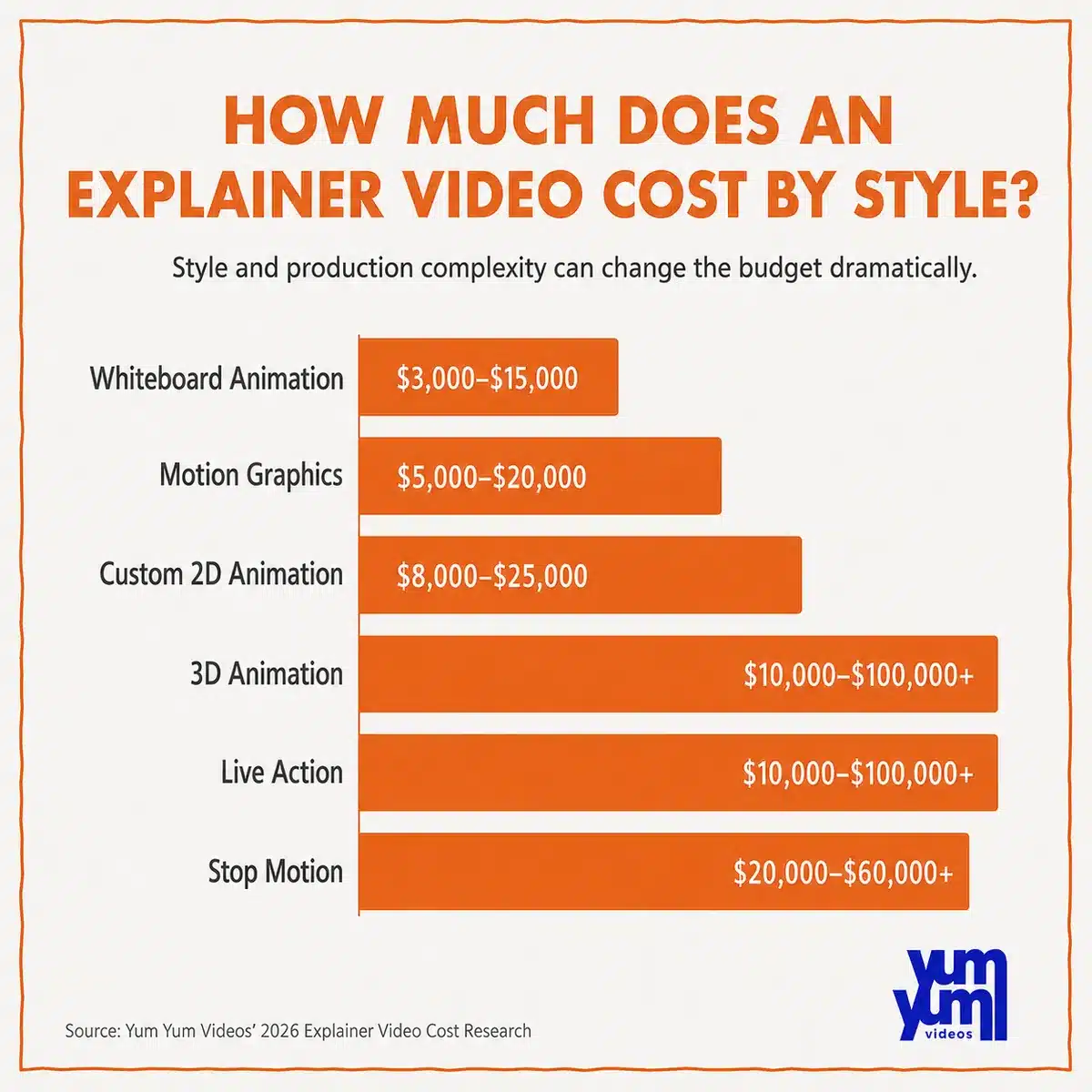
These ranges are useful for comparison, but they are not fixed rates. A simple 3D product rotation and a photorealistic 3D commercial are both 3D animation, yet their production requirements are completely different.
The same applies to every style listed here.
Traditional 2D Animation: $20,000 to $50,000+
Traditional 2D animation creates movement by drawing individual frames rather than relying primarily on reusable digital character rigs.
Today, the work is usually done digitally, but the basic production principle remains labor intensive.
The more frame-by-frame animation involved, the more drawing time is required. A 60-second project can start around $20,000 and exceed $50,000, particularly when scenes involve detailed character acting or complex movement.
Custom 2D Animation: $8,000 to $25,000
Custom 2D animation is one of the most common approaches for explainer videos.
Characters and environments are designed in two dimensions, but animators can use digital rigs and cut-out techniques instead of redrawing each character for every frame.
A character can be built once and then rigged so the animator can control arms, legs, facial expressions, and other elements independently.
This can make production more efficient than traditional frame-by-frame animation while still allowing the company to create original characters, backgrounds, and branded scenes.
Custom 2D explainer video pricing commonly falls between $8,000 and $25,000 for 60 seconds.
Motion Graphics: $5,000 to $20,000
Motion graphics uses animated graphic design elements such as shapes, typography, icons, diagrams, charts, interfaces, and data visualization.
It is often used when the subject involves software, financial information, processes, workflows, statistics, or concepts that do not require character-driven storytelling.
The production can range from relatively simple graphic movement to highly detailed sequences involving custom illustration, transitions, 3D elements, and advanced compositing.
A 60-second motion graphics explainer video project generally costs between $5,000 and $20,000.
Whiteboard Animation: $3,000 to $15,000
Whiteboard explainer videos are especially effective for educational content, processes, and ideas that are easier to understand step by step.
Its visual structure works well for educational content, processes, training, and subjects that benefit from being explained one step at a time.
A simple whiteboard production may use fewer backgrounds and less character animation than a detailed 2D piece.
Professional productions still require a script, storyboard, custom illustrations, animation, voiceover, music, and sound design.
Typical prices range from $3,000 to $15,000.
3D Animation: $10,000 to $100,000+
3D animation becomes particularly useful when you need to show something that is difficult to film or communicate in two dimensions.
Examples include a product’s internal components, industrial machinery, architecture, scientific processes, medical devices, or camera movements around a physical object.
The production pipeline can include modeling, texturing, rigging, lighting, animation, rendering, and compositing.
That makes the range unusually broad.
A relatively simple 3D animation may start around $10,000, while highly realistic or technically complex productions can exceed $100,000.
Live Action: $10,000 to $100,000+
Live action uses real locations, actors, presenters, products, and camera crews instead of creating every scene digitally.
It can work particularly well when the people behind a company are important to the story, when a physical product needs to be demonstrated, or when customer interviews are central to the project.
Production costs can include cameras, lighting, crew, talent, locations, permits, travel, props, editing, and post-production.
A straightforward shoot may begin around $10,000. Productions involving several locations, multiple shooting days, large crews, or higher-end cinematography can go well beyond $100,000.
Mixed Media and Live-Action Animation: $10,000 to $50,000+
Mixed media combines production techniques.
A project might use live-action footage with animated typography, interface graphics, 2D characters, visual effects, or 3D product elements.
The budget depends partly on whether the live-action footage already exists or needs to be filmed.
It also depends on how much animation has to be created and how tightly the animated elements need to interact with the footage.
Because two production workflows are involved, budgets often start around $10,000 and can exceed $50,000.
Stop Motion: $20,000 to $60,000+
Stop motion creates movement by physically changing an object’s position and photographing it repeatedly.
The technique can use clay figures, puppets, paper elements, physical products, or custom-built sets.
Even a few seconds of finished footage can require a large number of individual photographs.
The process also involves set construction, lighting consistency, precise object placement, and extensive planning.
Stop-motion production usually costs more because set construction, lighting, and frame-by-frame photography require substantial production time. Projects can start around $20,000 and move beyond $60,000 depending on the sets, materials, characters, and amount of animation required.
What to Look for When Hiring an Explainer Video Company
Price matters, but it is difficult to compare quotes until you know what each company is actually offering.
These are the areas we recommend reviewing before choosing a provider. Our guide to choosing an explainer video company goes deeper into how to compare providers.
Portfolio
Look beyond the agency’s single best-looking project.
Review several explainer video examples and check whether the company can adapt its work to different brands, audiences, industries, and visual styles.
If you need custom animation, make sure the portfolio actually contains custom work rather than projects assembled mostly from stock assets or templates.
Production Timetable
Ask how the explainer video production process is divided and when your team will need to provide feedback.
A good timetable should make the main approval stages clear, including the script, storyboard, illustration, animation, and final delivery.
This also helps you understand whether the proposed completion date is realistic.
Project Manager
Find out who will be your main point of contact.
On a multi-stage production, having someone responsible for deadlines, feedback, files, and coordination can save a considerable amount of internal time.
Art Direction
Ask whether the visual direction will be developed specifically for your project.
There is a major difference between designing a visual system around your brand and selecting characters, icons, and backgrounds from an existing asset library.
Neither method is inherently wrong, but they should not be priced or presented as the same service.
Feedback and Revisions
The proposal should explain when you can provide feedback and how many revision rounds are included.
Check the policy for the script, storyboard, illustrations, and animation separately.
Also ask what happens if you need additional revisions or request a substantial change after a stage has already been approved.
Quality Control
If you are hiring a larger production company, ask who reviews the work internally before it reaches you.
Some companies use senior animators, art directors, creative directors, or production leads to review different stages.
Understanding that process gives you a better idea of what the quote includes beyond the hours spent creating the assets themselves.
What Should an Explainer Video Quote Include?
Two proposals can show very different final prices because they include different services.
Before comparing the numbers, check whether each quote includes:
- Concept development and scriptwriting
- Storyboarding and art direction
- Custom illustration
- Animation
- Professional voiceover
- Music and sound design
- Project management
- Revision rounds
- Final rendering and deliverables
Then look at what is not included.
Possible additional costs can include rush production, extra revisions, premium music or voice talent, source files, alternative aspect ratios, shorter cutdowns, extra versions, and localization into other languages.
This is one of the easiest ways to avoid comparing two prices that appear similar but represent completely different scopes of work.
Explainer Video Cost: Frequently Asked Questions
1. Is Scriptwriting Included in the Price?
Most full-service video companies include scriptwriting as part of the production.
Freelancers and smaller studios may offer animation only or charge for scriptwriting separately.
Before signing a proposal, check whether the quote includes research, concept development, and scriptwriting rather than assuming they are part of the package.
2. Do I Need to Pay Separately for Music and Sound Effects?
Standard music licensing and sound effects are often included in professional production packages, but policies vary by company.
Original music, premium tracks, specific commercial songs, celebrity voice talent, or unusual licensing requirements can increase the price.
The same applies to voiceover. Ask whether the quote includes recording, casting, revisions, and the usage rights you need.
3. How Long Does It Take to Produce an Explainer Video?
A fully custom animated explainer typically takes around 6 to 8 weeks.
That timeline usually covers scriptwriting, storyboarding, illustration, animation, sound production, and client reviews.
Production can sometimes be accelerated, but a rush schedule may increase the cost.
4. Are There Hidden Costs I Should Know About?
A good proposal should make additional costs visible from the beginning.
Common additions include revisions beyond the agreed rounds, large changes requested after a production stage has been approved, rush delivery, premium music or voiceover licensing, source files, additional formats or edited versions, and localization into additional languages.
The best way to avoid surprises is to review the production scope and revision policy before the project begins.
5. Is a Custom Explainer Video Worth the Investment?
It depends on the role the project is going to play.
For a temporary internal presentation, early concept test, or low-risk piece of content, a template, AI tool, or freelancer may be enough.
A custom production becomes easier to justify when it needs to explain a difficult product, represent your company publicly, support a major launch, be used repeatedly by a sales team, or remain relevant for a long time.
What Our 2026 Explainer Video Pricing Research Found
For this guide, we contacted 125 video production companies and animation studios, reviewed 156 active freelance professionals, and compared 50 AI and DIY video platforms.
Of the 125 companies contacted, 76 responded.
Among those responses, 61 provided a usable estimate for a fully custom 60-second animated explainer video.
- The lowest usable agency quote was $2,800.
- The highest usable agency quote was $27,000.
- The median agency quote was $9,680.
- The average agency quote was $11,420.
- The median estimated production timeline was 7 weeks.
Among the freelance professionals reviewed, published rates generally ranged from $35 to $120 per hour, with a median of $62 per hour.
Project estimates ranged from roughly $1,200 for basic or animation-only work to $5,400 for more complete freelance productions.
Of the 50 AI and DIY video platforms we compared, 31 offered either a permanent free plan or a limited free tier.
The median paid plan was $39 per month, although generation limits, watermarks, export quality, available assets, and commercial usage rights differed substantially between platforms.
Pricing Sources and Methodology
We conducted the pricing research in July 2026.
Each production company received the same brief and visual references for a fully custom 60-second animated explainer video.
We compared quoted price, estimated production time, revision policy, and services included in the quote.
We then compared those findings with our experience producing more than 1,000 custom projects over 14 years.
Additional market references included data from the U.S. Bureau of Labor Statistics, The Animation Guild/IATSE, SAG-AFTRA, Upwork animator benchmarks for animators and 3D animators, public procurement budgets, and official pricing published by tools including Adobe Express, Canva, and Runway.
The figures throughout this guide are intended as market ranges rather than fixed prices.
Your actual quote will depend on duration, animation style, visual complexity, production team, deadline, revision policy, and the services included.
Research conducted and pricing last reviewed: July 2026.
Final Thoughts on Explainer Video Costs
There is no single standard price for an explainer video because the term covers very different types of production.
A $500 template project, a $3,000 freelance animation, and a $20,000 custom agency production are not simply expensive and inexpensive versions of the same product. They involve different people, processes, assets, timelines, and levels of creative control.
Start with what the project needs to accomplish.
Then compare providers based on the work actually included in their quotes.
For a short-lived test, paying for a large custom production may make little sense. For a piece that has to explain your flagship product to thousands of prospects, choosing solely on the lowest price can create a different kind of cost later.
Understanding the production model, revision policy, team, timeline, and deliverables will give you a much more useful comparison than the final number alone.
Estimate Your Explainer Video Cost
To get an estimate based on your video’s style, length, and production needs, try our Instant Video Cost Calculator or tell us about your project, and we’ll help you understand what kind of production and budget it may require.

Victor Blasco
Co-founder of Yum Yum Videos | Explainer Video & Video Marketing Expert
Victor Blasco has over 25 years of experience in animation and film production. For the past 14+ years, he has worked with companies to create explainer and marketing videos that simplify complex ideas and drive business results.
His work has supported global brands like Amazon and McKesson, as well as startups that raised over $2B and reached unicorn or IPO stages.
Victor shares insights based on real client work. His contributions have been published on platforms like Social Media Examiner, and he has been featured or quoted in outlets such as Forbes.