10 Best Explainer Video Case Studies With Real Business Results

Co-founder of Yum Yum Videos | Explainer Video & Video Marketing Expert

Across these projects, the communication problem was different each time. Accelerant needed different stories for members and investors. DocuSign needed to explain digital agreement workflows across multiple industries. ZenBusiness had to explain legal basics to first time founders.
The 10 explainer video case studies below come from projects we produced at Yum Yum Videos, an explainer video company that works with SaaS, healthcare, finance, education, and other complex industries.
Across these 10 cases, our work accompanied companies during fundraising, product launches, market expansion, digital adoption, and enterprise sales.
We report video metrics such as views and documented usage separately from company milestones such as funding, revenue, valuation, AUM, adoption, and contracts.
If you are looking for creative references first, our guide to the best explainer videos focuses more closely on script, animation, pacing, and visual choices. This article focuses on how explainer videos were used inside real business situations.
TL;DR
- These explainer video case studies cover 10 projects across SaaS, fintech, healthcare, education, finance, legal tech, aerospace, and enterprise software.
- Each case shows what the company needed to communicate and which audience the video was built for.
- The projects include investor communication, product launches, market expansion, onboarding, enterprise sales, and product education.
- Several clients returned for multiple videos because different audiences needed different versions of the same core story.
- Direct video results and broader company milestones are identified separately throughout the article.
10 Explainer Video Case Studies at a Glance
| Company | Video job | Video scope | Business milestone |
|---|---|---|---|
| Accelerant | Explain a complex insurtech platform to several audiences | 9 explainer videos | $724M IPO at a $6.4B valuation |
| BrightInsight | Explain regulated digital health software | 2 explainer videos | $101M Series C and 431% revenue growth over the reported period |
| McGraw Hill | Explain new digital learning products | 3 product explainers | 7.2% digital revenue growth and about 95% Evergreen instructor adoption |
| Chargebee | Make subscription billing and RevOps easier to understand | 3 explainer videos | $1.4B valuation in 2021, later $3.5B |
| BetterUp | Explain coaching to users and enterprise leaders | 2 videos | $100M+ ARR and $4.7B valuation |
| Advisors Capital Management | Explain investment strategies and services | Explainer series | $9.5B AUM |
| DocuSign | Explain digital agreement workflows across multiple industries | 8 explainer videos | 36% YoY revenue growth and $6B market debut |
| ZenBusiness | Teach first time founders legal basics | 3 educational explainers | $200M Series C at a $1.7B valuation |
| Sintavia | Visualize additive manufacturing for aerospace and defense | 1 technical 3D explainer | DoD contract under the $106.7M GAMMA-H program |
| Spigit | Explain crowd science and innovation algorithms | 2 whiteboard explainers | 120% year-over-year growth in Q2 2016 and later Planview acquisition |
You can also explore our full client case studies for more examples across industries.
How to Read These Explainer Video Case Studies
I selected projects where we know the production work firsthand and can separate the job of the video from the business milestones around it.
- Communication need: What did the company need to explain?
- Audience: Who needed to understand it?
- Role of the video: Where and how was the explainer used?
- Video evidence: Which metrics describe the video itself?
- Business context: What was happening at the company during that period?
A view count, conversion, click, or documented use can describe the video itself. Funding, revenue, valuation, AUM, adoption, acquisitions, and contracts describe the company. The cases below show both when the information is available.
1. Accelerant: 9 Explainer Videos Through $340M+ in Funding and a $6.4B NYSE Debut
Accelerant’s communication needs changed as the company grew. Its data driven insurance model had to make sense to members, partners, clients, and investors, and those groups did not all need the same explanation.
Between 2021 and 2024, we produced nine animated explainers. Some introduced the platform. Others focused on investors, new members, or specific insurance problems. We reused the same visual system across the series, allowing each new video to address a different audience without rebuilding the visual language from scratch.
During the period we worked together, Accelerant raised more than $340 million in private funding. In 2025, after our production period, Accelerant and some of its shareholders sold approximately $724 million in stock through its NYSE IPO. When the shares began trading, Reuters reported a fully diluted valuation of about $6.4 billion. Reuters covered the IPO.
Accelerant used a series rather than asking one explainer to carry every investor, partner, member, and client message. As new communication needs appeared, the company added videos while keeping the same visual language. The Accelerant case study follows how the nine pieces developed from 2021 to 2024.
2. BrightInsight: Explaining Regulated Digital Health During 431% Revenue Growth
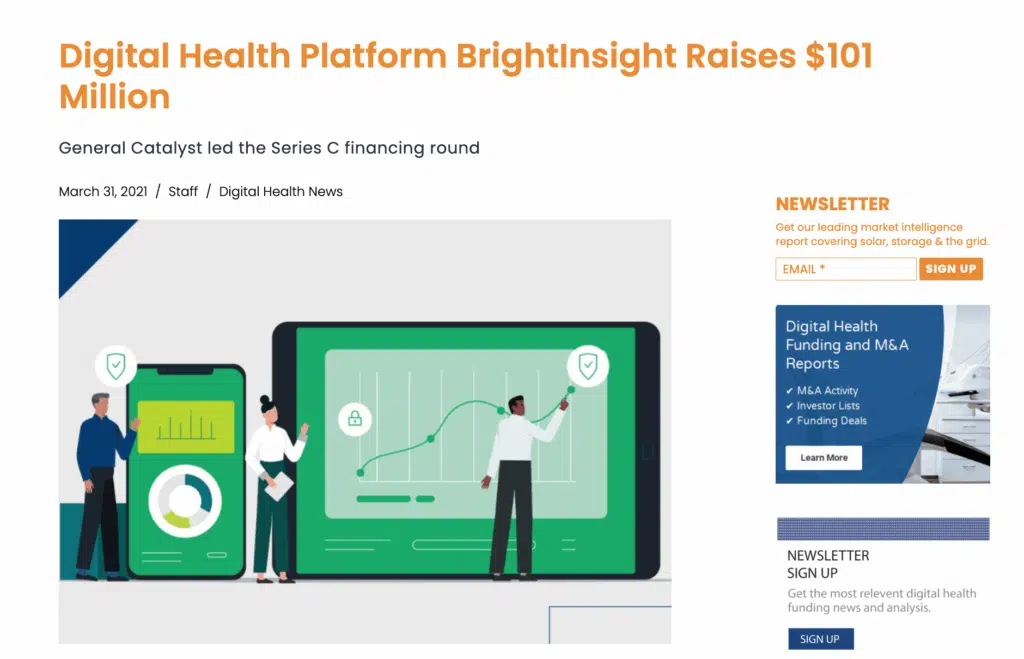
BrightInsight needed to explain a regulated digital health platform to pharmaceutical teams, clinicians, partners, and investors. The challenge was making the system easier to follow while preserving the technical detail the audience expected.
We produced two explainer videos around the platform and its disease management solution. Motion graphics and restrained interface metaphors gave the information a visual hierarchy while the language stayed appropriate for a professional healthcare audience.
BrightInsight raised a $101 million Series C. The company also reported 431% revenue growth from 2019 to 2022 in connection with its Deloitte Technology Fast 500 recognition. Our work accompanied BrightInsight during the broader period in which the company was expanding its platform and partner communications.
The BrightInsight case study documents the two videos and the growth timeline.
.
3. McGraw Hill: Product Explainers During a Major Digital Learning Shift
McGraw Hill needed to introduce digital products to instructors and students without making the transition feel more complicated than the classroom problem it was meant to solve.
We created three product explainers for GO, Sharpen, and Evergreen. Each piece focused on how a specific product fits into an existing teaching or learning workflow, and the videos were embedded on official product pages.
McGraw Hill later reported 7.2% year over year digital revenue growth, with digital products representing 61% of total revenue. The company also reported approximately 95% acceptance rate among instructors receiving the Evergreen update.
The videos accompanied McGraw Hill’s broader move toward digital learning by explaining GO, Sharpen, and Evergreen to instructors and students. Our McGraw Hill case study covers the three projects and their use.
4. Chargebee: 3 Explainers for Subscription Billing and Revenue Operations
Chargebee solves problems that are difficult to see on screen. Subscription logic, revenue recognition, taxes, failed payments, and billing workflows mostly happen behind the interface.
In 2020, Chargebee commissioned three animated explainers from us. One creative decision was to turn ideas such as leaks and tangled billing into literal visual problems. That gave viewers a way to see the underlying problem before the script moved deeper into the software.
One core explainer passed 265,000 views on YouTube, a direct result from the video. Chargebee raised $55 million in 2020 and $125 million in 2021, reaching a $1.4 billion valuation. In 2022, it raised another $250 million at a $3.5 billion valuation.
Our three-video project began in 2020, before Chargebee reached the later valuations listed above. The videos gave customers and prospects a visual way to understand subscription billing and revenue operations. The Chargebee case study covers the production timeline.
Chargebee also appears in our SaaS explainer video case studies alongside other software projects.
5. BetterUp: Two Explainers for Two Different Audiences
.
BetterUp needed two versions of the story for two different audiences.
We produced two videos. One introduced the coaching platform to a broad user audience. The second focused on sales performance and enterprise leaders. Each audience needed different context, emphasis, and detail.
During the broader growth period, BetterUp passed $100 million in ARR, reported more 80% customer-base growth over the cited period, and raised a $300 million Series E at a $4.7 billion valuation.
We worked with BetterUp during that period with one video introducing the platform broadly and another speaking directly to enterprise leaders. The BetterUp case study covers how the two pieces addressed those audiences.
Audience and script decisions happen before animation begins, as shown in our explainer video production process.
6. Advisors Capital Management: Long Term Explainers for a $9.5B AUM Firm
Financial services video has a different communication constraint. The audience needs clarity, while the tone also has to fit a regulated category where trust and precision are part of the message.
For Advisors Capital Management, we created a series of animated explainers around investment strategy and services. The videos were built as evergreen assets and continued to appear across core pages long after the initial production.
Advisors Capital Management later reported more than $9.5 billion in assets under management. During that period, the explainers remained in use across core pages, giving the firm one visual approach for explaining its investment strategies and services over several years.
The Advisors Capital Management case study documents the explainer series and its long term use.
7. DocuSign: 8 Explainer Videos Before a ~$6B Market Debut
.
DocuSign needed to explain digital agreement workflows across multiple industries without reducing the message to a generic e-signature demo.
Between January and September 2017, we produced eight custom explainer videos for the company. Each video was adapted to a different business context, including financial services, real estate, insurance, life sciences, HR, sales, procurement, and SMBs. The goal was to make DocuSign’s platform easier to understand while reinforcing trust, security, and compliance across different audiences. The DocuSign case study covers the full project.
During the broader pre-IPO period, DocuSign reported 36% year-over-year revenue growth, increasing revenue from $381.5 million to $518.5 million. In April 2018, the company completed its IPO at $29 per share, raising approximately $629 million. On its first day of trading, DocuSign closed with a market capitalization of about $6 billion. The SEC filing documents the revenue growth and IPO, while TechCrunch reported the approximately $6 billion market capitalization at the close of its market debut
We’re proud that our eight-video collaboration formed part of DocuSign’s communications during this pre-IPO growth period, helping the company explain its digital agreement platform clearly to different industries and business audiences.
8. ZenBusiness: Educational Explainers for First Time Founders
ZenBusiness had a trust problem built into the category. First time founders often arrive with basic legal questions about LLC formation, registered agents, operating agreements, and compliance.
The project included three educational explainers about those topics. We used straightforward language and a friendly visual system so first time founders could follow the legal steps in the order they were likely to encounter them.
During that broader period, ZenBusiness raised a $200 million Series C at a $1.7 billion valuation. The educational explainers accompanied a period in which the company was reaching a large audience of new founders.
For ZenBusiness, the first job was education. The videos explained LLC formation, registered agents, operating agreements, and compliance before asking the viewer to understand the service itself.
9. Sintavia: A 3D Explainer for Advanced Additive Manufacturing
Sintavia works in aerospace and defense manufacturing, where the process itself is highly technical and difficult to capture with ordinary footage.
We produced a 3D explainer that visualized additive manufacturing workflows for industry, defense, and government audiences. The 3D format gave us control over spatial relationships and engineering detail throughout the explanation.
In 2024, Sintavia received a U.S. Department of Defense contract as part of GAMMA-H, a $106.7 million hypersonic manufacturing program. The video had been created to explain the company’s technical capabilities to aerospace, defense, government, and industry audiences, and trade media later embedded it when covering the technology.
The Sintavia case study documents the production and the later company milestone.
10. Spigit: Two Whiteboard Explainers During a Record Sales Year
Spigit had to explain crowd science and innovation algorithms to enterprise executives. The product logic was abstract, and a formal software demo would not have solved the whole communication problem.
Pairwise and Predictions were the two whiteboard explainer videos we produced for Spigit. A recurring Professor Spigit character and visual metaphors guided the audience through the scoring logic.
In 2016, Spigit reported 120% year-over-year growth in Q2 2016 and expanded its Fortune 500 client base. Planview later acquired the company in 2018. During that growth period, the whiteboard explainers were used in enterprise sales conversations, executive presentations, and targeted campaigns to explain the underlying crowd science.
The Spigit case study includes the project timeline. The same two videos also appear in our whiteboard explainer video guide.
Patterns Across These 10 Explainer Video Projects
They Start With the Communication Problem
Accelerant needed a system for several audiences. DocuSign needed to adapt the same platform story to different industries and use cases. Sintavia needed a visual model for a technical process. Each project started from a different explanation problem.
They Match the Detail to the Audience
BrightInsight could preserve professional healthcare language. ZenBusiness needed to start with legal basics. BetterUp split the message because end users and enterprise leaders needed different context.
They Give Invisible Ideas a Visual Form
Chargebee turned billing logic into visual metaphors. Spigit used whiteboard drawings for crowd science. Sintavia used 3D for manufacturing processes and spatial relationships.
They Are Built for a Specific Use
Accelerant created different videos for investors, members, and other audiences. McGraw Hill embedded product explainers on official product pages. Spigit used its videos in enterprise sales conversations, executive presentations, and targeted campaigns. Advisors Capital Management kept evergreen explainers on core pages over several years.
For explainer video ROI, measure the result that matches the job of the asset. That may include views, completion rate, clicks, conversions, sales usage, support reduction, sales cycle length, or win rate. Funding, revenue, valuation, AUM, acquisitions, and contracts remain company metrics unless direct attribution data connects them to the video.
Explainer Video Case Study FAQ
What should an explainer video case study include?
It should explain the original communication problem, the audience, the production approach, where the video was used, direct video evidence when available, and the business context around the project.
Can an explainer video be linked to funding or revenue growth?
An explainer can accompany fundraising or growth by helping investors, customers, and partners understand the product, business model, or opportunity. Funding and revenue are company results, so direct attribution requires evidence connecting the video to that outcome.
What is a B2B explainer video use case?
Common B2B uses include investor communication, sales enablement, product education, onboarding, partner communication, category education, and support. Our B2B explainer videos guide covers those situations in more detail.
How much does a professional explainer video cost?
Cost depends on length, animation style, complexity, revisions, and deadline. Our guide to explainer video cost explains the main variables and current pricing ranges.
Are the best explainer videos always the ones with the most views?
No. A video created for a niche enterprise audience may be valuable with relatively few views if it reaches the buyers, partners, investors, or users it was made for. The metric should match the job of the video.

Victor Blasco
Co-founder of Yum Yum Videos | Explainer Video & Video Marketing Expert
Victor Blasco has over 25 years of experience in animation and film production. For the past 14+ years, he has worked with companies to create explainer and marketing videos that simplify complex ideas and drive business results.
His work has supported global brands like Amazon and McKesson, as well as startups that raised over $2B and reached unicorn or IPO stages.
Victor shares insights based on real client work. His contributions have been published on platforms like Social Media Examiner, and he has been featured or quoted in outlets such as Forbes.