8 B2B Video Examples: Different Types and How to Make Them Work

Co-founder of Yum Yum Videos | Explainer Video & Video Marketing Expert
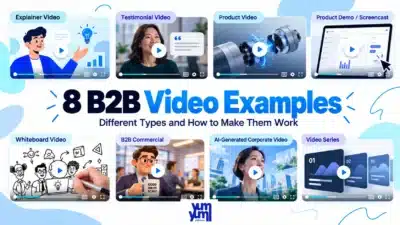
Looking for B2B video examples to inspire your next project? We’ve selected eight videos covering different formats, from animated explainers and product demos to testimonials, corporate videos, and commercials.
We’ll share practical production tips, explain some of the creative decisions behind these videos, and help you choose the right type of B2B video for your business.
At Yum Yum Videos, we’ve spent over 14 years producing videos for companies like Amazon, Google, McKesson, and startups that have reached multibillion-dollar valuations. We’ll also share a few things we’ve learned from working on these projects ourselves.
Let’s get into the examples!
1. B2B Explainer Videos: Chargebee
B2B explainer videos introduce a product or service, explain how it works, and show why it matters. They’re particularly popular among SaaS and technology companies that need to communicate complex solutions in a short amount of time.
.
At Yum Yum Videos, we produced three animated explainer videos for Chargebee, a subscription billing platform, during a period when the company raised hundreds of millions in funding and eventually reached a $3.5 billion valuation.
Like most explainers, the videos introduce a problem, present the solution, and explain why Chargebee is a good choice. In this particular explainer video example, we relied heavily on visual storytelling.
In one scene, team members get tangled in cables and pull against each other, representing friction between departments. Then, water rises around them, showing how those difficulties can become overwhelming.
These visual metaphors communicate the frustration in just a few seconds, leaving more time to explain the solution.
When creating a B2B explainer video, start with your audience’s pain points rather than a long list of features. Then think about how to represent those problems visually. A clever metaphor, engaging animation, and a distinctive art style can make even a complicated message easier to understand and remember.
2. B2B Testimonial Videos: HubSpot About Zoom
B2B testimonial videos feature customers explaining how a product or service helped them. They typically combine interviews with footage of offices, employees, and everyday work situations.
This isn’t the most creative testimonial video ever made. It’s actually pretty traditional. But look who’s talking: HubSpot employees sharing their experience with Zoom and Slack!
When planning a testimonial video, try to feature your most recognizable customer, a respected company in your industry, or someone your target audience knows. Hearing a recommendation from an established brand can carry considerable weight, especially in B2B purchases where trust plays such an important role.
Production still matters, of course. Use a proper three-point lighting setup, record the interview from multiple camera angles, and capture additional footage of the office and team. Those shots will help you illustrate the story and make the editing more dynamic.
You can get creative with the visuals afterward, but choosing the right customer should be your first priority.
3. B2B Product Videos: Sintavia
B2B product videos focus on a product’s features, capabilities, and what makes it different. They can go deeper into technical details than a traditional explainer, especially when the audience already understands the industry.
We created this 3D animated video for Sintavia, an advanced manufacturing company specializing in 3D-printed aerospace and defense components.
Since the company works with 3D printing, animation was a particularly good fit. We could show the technology, visualize complex processes, and give viewers a closer look at capabilities that would be difficult to explain through narration or traditional footage.
The result helped Sintavia communicate what it does. As Christina Kurth from the company put it:
“So what do you say you do? The answer to that question just got a lot easier.”
In 2024, Sintavia also secured a $106.7 million U.S. Department of Defense contract, a major milestone during this period of growth.
For industrial or technical B2B videos, think about what your audience needs to see. That could mean showing machinery in action, revealing a product’s internal components, or demonstrating a process that would be impossible to film.
3D animation is especially useful for these situations, although it’s worth investing in that level of production only when the visuals genuinely help explain the product.
You can read more in our Sintavia case study.
4. B2B Product Demo Videos: SurveyMonkey
B2B product demo videos show how a product works in practice. They’re particularly useful for potential customers who already know what your company offers and want to evaluate the product before making a decision.
The SurveyMonkey video starts with a short introduction and upbeat music before moving directly into the platform.
At first glance, it looks like a simple screencast. But pay attention to how the interface moves, where the camera zooms in, and how quickly each action happens.
There’s a lot of planning behind a polished product demo. Motion graphics help direct the viewer’s attention, transitions connect different actions, and the editing removes unnecessary steps that would slow everything down.
A regular screen recording might show the exact same software, but it probably wouldn’t explain it nearly as well.
If you’re producing a B2B product demo, choose the most important interactions, plan the sequence carefully, and keep the pacing tight. You want viewers to understand how the product works without having to watch someone click through every button and menu.
5. B2B Whiteboard Videos: MedVector
Whiteboard animation is a style of explainer video, but it deserves a separate mention. Its hand-drawn aesthetic can make complex or serious topics easier to approach, sometimes introducing a little humor without losing the professional tone.
At Yum Yum Videos, we produced three whiteboard videos for MedVector, a healthcare technology company developing a new approach to clinical trials.
MedVector needed to explain a complex model involving patients, physicians, and research investigators. Whiteboard animation allowed us to introduce each part of the process through simple illustrations, building the explanation step by step.
The company raised $3.5 million in total funding during its development, and co-founder Scott Stout shared this comment about our work:
“Their ability to understand complex topics and visualize them was amazing. We’ve raised $3.5m with a lot of help from Yum Yum Videos!”
For healthcare and other technical industries, whiteboard animation can be a practical choice when there’s a lot of information to communicate. You can introduce concepts gradually, use simple characters to represent different roles, and add touches of humor to make serious subjects more approachable.
Just make sure the illustrations remain simple enough that viewers can follow the explanation without getting distracted.
Read more in our MedVector case study.
6. B2B Commercial Videos: Slack
Who says B2B videos have to be boring?
B2B commercials usually focus on attracting attention, building awareness, and making a brand memorable. They don’t necessarily need to explain every product feature, which gives you more freedom to experiment with storytelling.
Slack’s “So Yeah, We Tried Slack” is a classic live-action B2B marketing video, and one of my favorites.
The video follows a team dealing with familiar workplace frustrations and uses humor to demonstrate why better communication matters.
The jokes come from situations the audience recognizes, so viewers can understand the product’s benefits as the story unfolds.
Humor can work very well in B2B advertising, especially when the target audience deals with the same everyday problems.
But there’s a catch: you need to understand your audience. A funny video aimed at startup founders might not work for a highly specialized medical or industrial audience.
If you’re going to use humor, make sure it’s connected to the product and the people you’re trying to reach.
7. Corporate B2B Videos: AI-Generated Meet the Team
Corporate B2B videos introduce a company’s people, culture, or values. Traditionally, that means filming offices, interviewing executives, and showing employees at work.
AI is now giving companies another way to approach these productions.
This video uses AI-generated visuals to introduce a team, giving a familiar corporate video format a different visual approach.
AI allows creators to explore unusual environments, experiment with different aesthetics, and develop concepts that might otherwise require elaborate sets or visual effects.
Still, AI-generated footage needs creative direction. Maintaining visual consistency, refining individual shots, and making everything fit together can require considerable editing.
For a B2B corporate video, I’d start with the company’s personality and the impression you want viewers to take away. Then decide whether live action, animation, AI, or a combination of techniques is the best way to communicate it.
8. B2B Video Series: Accelerant
Sometimes, a company has too much to communicate in a single video. Different products, audiences, or business processes may each need their own explanation.
That’s where a B2B video series becomes useful.
Between 2021 and 2024, we produced nine animated explainer videos for Accelerant, an insurtech company with a sophisticated business model.
Why nine?
Accelerant needed to communicate different aspects of its business to different audiences. We developed individual videos addressing specific topics while maintaining a consistent visual identity across the series.
During our collaboration, Accelerant raised hundreds of millions in private funding. In 2025, the company went public through a $724 million IPO, reaching an initial valuation of approximately $6.4 billion.
Our videos accompanied its communication efforts during this period of growth.
For companies considering multiple B2B videos, I’d recommend planning the series before producing the first one. Define the audiences, the topics each video needs to cover, and which visual elements should remain consistent.
That way, you can reuse certain creative assets, maintain a recognizable style, and avoid explaining the same things repeatedly.
How to Choose the Right Type of B2B Video
Before deciding on an animation style or production technique, think about what you need your B2B video to accomplish.
Here’s a quick reference based on the examples we’ve covered:
| Your goal | Recommended B2B video type |
| Introduce a product or service | Explainer video |
| Show how a product works | Product demo |
| Highlight technical capabilities | Product video or 3D animation |
| Build trust with potential customers | Customer testimonial |
| Explain complex information | Whiteboard animation |
| Increase brand awareness | B2B commercial |
| Introduce your company and team | Corporate video |
| Communicate different topics or services | B2B video series |
The buyer’s journey matters too.
Someone discovering your brand for the first time might benefit from an explainer or commercial. A prospective customer comparing solutions may prefer a product demo, while a testimonial can provide reassurance before a purchase.
Define your audience, message, and marketing objective before deciding which type of B2B video content to produce.
Final Thoughts
Before starting production, decide what you want viewers to understand or do after watching your video. That decision will influence everything else, from the script and visual style to the length and format.
A 60-second explainer can’t cover every product feature. A testimonial needs the right customer. And a product demo needs careful editing to show what matters without dragging on.
At Yum Yum Videos, we’ve been helping businesses turn complex ideas into custom videos for over 14 years. If you’re planning your next B2B video, we’d be happy to discuss what might work for your project.
Frequently Asked Questions About B2B Videos
What are the different types of B2B videos?
The most common types include explainer videos, product demos, corporate videos, customer testimonials, training videos, and B2B commercials.
Each serves a different purpose. Explainers introduce products, demos show how they work, testimonials build trust, and commercials help increase brand awareness.
You can also choose between different production styles, including 2D animation, motion graphics, whiteboard, 3D animation, live action, and AI-generated video.
How much does a B2B video cost?
B2B video production costs depend on the length, complexity, style, and quality you’re looking for.
As a general reference, professionally produced custom B2B videos often cost between $6,000 and $20,000, although elaborate commercials and complex 3D productions can cost considerably more.
Simpler internal or training videos may cost between $1,000 and $6,000, while DIY and AI tools offer less expensive alternatives.
For animated explainers specifically, our 2026 research analyzed 61 usable quotes from production companies and found a median price of $9,680 for a custom 60-second video.
You can read the full findings in our guide on how much an explainer video costs.
Should B2B videos be animated or live action?
It depends on what you’re trying to communicate.
Animation works particularly well for SaaS platforms, complex technologies, and products that are difficult to show on camera.
Live action is often a better fit for interviews, customer testimonials, and corporate videos where real people are part of the message.
There are exceptions, of course. Slack’s live-action commercial is a good example of using humor and storytelling to promote software.
How long does it take to produce a B2B video?
Most professionally produced B2B videos take around 4 to 8 weeks, depending on the format and complexity.
Production typically includes scripting, visual development, recording or animation, editing, sound design, and revisions.
Simpler videos can be completed faster, while complex 3D animations or large live-action productions may take longer. AI can speed up certain stages, although generating consistent visuals and refining the final video still requires work.
What makes a good B2B video?
Start with a clear message and a well-defined audience.
Think about the problem you want to solve, what viewers already know, and what you want them to understand or do after watching.
Then choose the right format and production style. A product demo needs clear visual explanations, a testimonial needs a credible customer, and a commercial needs a story that connects with its audience.
The production decisions should support that goal, from the script and visual style to the editing and final call to action.

Victor Blasco
Co-founder of Yum Yum Videos | Explainer Video & Video Marketing Expert
Victor Blasco has over 25 years of experience in animation and film production. For the past 14+ years, he has worked with companies to create explainer and marketing videos that simplify complex ideas and drive business results.
His work has supported global brands like Amazon and McKesson, as well as startups that raised over $2B and reached unicorn or IPO stages.
Victor shares insights based on real client work. His contributions have been published on platforms like Social Media Examiner, and he has been featured or quoted in outlets such as Forbes.